


Complete Guide to Outsourcing E-commerce Accounting

Business professional holding a tablet next to text about outsourcing ecommerce accounting

Complete Guide to Outsourcing E-Commerce Accounting

The Canadian e-commerce landscape has transformed dramatically, with market value reaching US$89.4 billion in 2024 and projected to grow at a 7.38% CAGR through 2028. 

As 54% of Canadian SMBs now outsource e-commerce accounting, traditional in-house approaches struggle to meet the demands of multi-platform financial management.

Outsource e-commerce accounting has evolved from a cost-saving tactic into a strategic necessity. The convergence of complex GST/HST regulations, multi-channel reconciliation, and real-time reporting demands specialised expertise. 

This guide examines how Canadian CPAs and accountants can leverage outsourced solutions to navigate modern e-commerce financial management while maintaining compliance and delivering superior client value.

Key Takeaways

  • 79% of Canadian businesses will adopt outsourced accounting by 2025, driven by complex compliance requirements and technological demands
  • E-commerce bookkeeping requires specialised handling of platform fees, inventory valuation, and multi-jurisdictional sales tax across Shopify, Amazon, and direct channels
  • Offshore e-commerce accountants provide cost efficiencies of 40-50% compared to in-house teams while delivering CPA-level expertise in Canadian regulations
  • Xero and Amazon integration automation reduces reconciliation time by 85% and eliminates manual data entry errors
  • Tax accounting in e-commerce demands proactive GST/HST registration at the $30,000 CAD threshold and meticulous tracking of marketplace facilitator obligations

The Strategic Shift Toward Outsourced E-Commerce Accounting

Canadian accounting practices face mounting pressure as e-commerce clients expand across multiple platforms. The traditional model of employing full-time outsourcing bookkeepers for transaction processing has become financially unsustainable and operationally limiting. 

Research indicates that 36.5% of Canadian businesses outsourced professional services, including accounting, in Q1 2025, with adoption rates climbing from 55% to 75% between 2018 and 2023.

Why Canadian CPAs Are Embracing Outsourcing

Cost Efficiency Without Compromise

Maintaining specialised e-commerce accounting expertise in-house requires significant investment. Salaries for professionals with multi-platform experience exceed $65,000 annually, plus benefits, training, and software licensing. 

When you outsource e-commerce accounting, solutions reduce these operational costs by 40-50% while providing access to teams already proficient in Shopify bookkeeping, Amazon accountant for an e-commerce business functions, and cross-border compliance.

Access to Specialised Platform Expertise

E-commerce accounting extends beyond traditional bookkeeping. Each platform presents unique challenges:

PlatformAccounting ComplexityKey Challenges
ShopifyModerate-HighMulti-currency, payment gateway fees, and sales tax by province
AmazonHighFBA fees, storage costs, referral charges, and marketplace tax collection
Multi-channelVery HighInventory sync, fee reconciliation, unified reporting
Office professional using a tablet while reviewing work in a modern workspace

Scalability During Peak Periods

E-commerce transactional volume fluctuates dramatically during holiday seasons, product launches, and promotional events. Outsourced teams scale resources within 48-72 hours without HR complications, ensuring continuous service delivery during critical reporting periods.

Understanding E-commerce Bookkeeping Fundamentals

E-commerce bookkeeping differs fundamentally from traditional retail accounting. The digital nature of transactions creates data complexity that demands systematic automation and specialised knowledge.

Core Challenges in E-Commerce Financial Management

Platform Fee Reconciliation

Amazon charges 15% referral fees plus FBA storage and fulfilment costs that vary by product dimensions and seasonality. Shopify merchants face 2% transaction fees on external payments plus subscription tiers from $39 to $399 monthly. Accurate bookkeeping requires mapping these fees to correct expense categories while maintaining gross margin integrity.​

Inventory Valuation Complexities

Unlike traditional retail, e-commerce inventory exists across multiple locations: FBA warehouses, third-party logistics providers, and direct merchant facilities. The cost of goods sold must account for inbound shipping, customs duties, storage fees, and returns processing. Misclassifying inventory as immediate expenses remains the third most common accounting error among Canadian e-commerce sellers.​

Multi-Jurisdictional Sales Tax Compliance

The 2018 South Dakota v. Wayfair decision triggered economic nexus laws across Canadian provinces, requiring sellers to register for GST/HST once taxable revenues exceed $30,000 CAD in any rolling 12-month period. Four provinces operate under HST (13-15%), while others maintain separate PST systems, creating a compliance matrix that changes based on customer location.​

Essential Bookkeeping Practices

PracticeImplementationImpact
Separate Business BankingDedicated accounts per sales channelReduces reconciliation errors by 60%
Automated Transaction SyncReal-time integration via A2X or Link My BooksSaves 15–20 hours monthly
Monthly Account ReconciliationMatch platform payouts to bank depositsIdentifies discrepancies within 24 hours
Inventory Tracking by SKUPerpetual system with COGS analysisImproves gross margin accuracy by 35%

Platform-Specific Accounting Requirements

Shopify Bookkeeping Essentials

Canadian Shopify merchants must navigate provincial tax variations while managing payment gateway diversity. Shopify bookkeeping requires:

  • Transaction-level accounting to identify profit centres by product, channel, and marketing campaign
  • GST/HST collection based on the customer’s province, not the merchant’s location
  • Payment processor reconciliation for PayPal, Stripe, and Shop Pay transactions
  • Refund and chargeback tracking to maintain accurate revenue recognition

Common Shopify Accounting Mistakes:

  • Recording gross deposits as revenue without fee deduction
  • Failing to separate shipping income from product sales
  • Ignoring gift card liability accounting
  • Misclassifying marketing apps as operating expenses rather than COGS

Amazon Accountant for E-commerce Business Operations

An Amazon accountant for an e-commerce business functions demands specialised knowledge of marketplace mechanics. The platform’s complexity creates unique compliance risks:

Key Amazon Accounting Challenges:

  • FBA fee structures include variable closing fees, storage costs, and long-term storage penalties that change quarterly
  • Marketplace Facilitator Tax collection began in 2021, but sellers remain responsible for non-marketplace sales and wholesale orders​
  • Multi-country inventory triggers customs valuation and transfer pricing considerations
  • Advertising cost of sales (ACoS) must be allocated across SKUs for accurate profitability analysis

Critical Compliance Requirement: Amazon’s data retention policies provide only 24 months of transaction history. Professional accounting services must implement automated backup systems to preserve records for CRA’s six-year audit requirement.​

Tax Accounting in E-commerce: GST/HST Compliance

Tax accounting in e-commerce represents the most complex aspect of Canadian online retail financial management. The CRA has intensified enforcement, with enhanced data-sharing arrangements with payment processors and marketplaces to identify non-compliant sellers.​

GST/HST Registration and Filing Obligations

Mandatory Registration Threshold: $30,000 CAD in taxable revenues within any 12-month period triggers GST/HST registration requirement. This includes:​

  • Direct website sales
  • Marketplace transactions (even if tax is collected by the platform)
  • Digital product revenues
  • Service commissions

Filing Frequency Based on Revenue:

  • Annual filing: Under $1.5 million CAD
  • Quarterly filing: $1.5 million to $6 million CAD
  • Monthly filing: Over $6 million CAD

Electronic Filing Mandate: 

Since 2024, electronic filing is mandatory for all businesses with limited exceptions, eliminating paper-based submissions.

Provincial Tax Variations

ProvinceTax TypeRateFiling Requirement
OntarioHST13%Combined federal/provincial return
British ColumbiaGST + PST5% + 7%Separate PST filing required
AlbertaGST5%Federal only
QuebecGST + QST5% + 9.975%Separate QST registration
Atlantic ProvincesHST15%Combined return

Marketplace Facilitator Rules

Since July 2021, major platforms have been collecting and remitting GST/HST on behalf of unregistered sellers. However, this does not relieve sellers of all obligations:​

  • Sellers must still register once thresholds are exceeded
  • Direct sales through non-marketplace channels require seller collection
  • Input Tax Credits can only be claimed by registered businesses
  • Wholesale orders remain the seller’s tax responsibility

CRA Enforcement Priority: The 2025 audit focus targets unregistered sellers exceeding thresholds and foreign suppliers using simplified registration schemes improperly.

Offshore E-commerce Accountants: Strategic Considerations

Offshore accountants provide Canadian firms with 24/7 operational capability and specialised expertise at competitive rates. The Canadian BPO market generated USD 28.9 billion in 2024, with projections reaching USD 46.7 billion by 2030.​

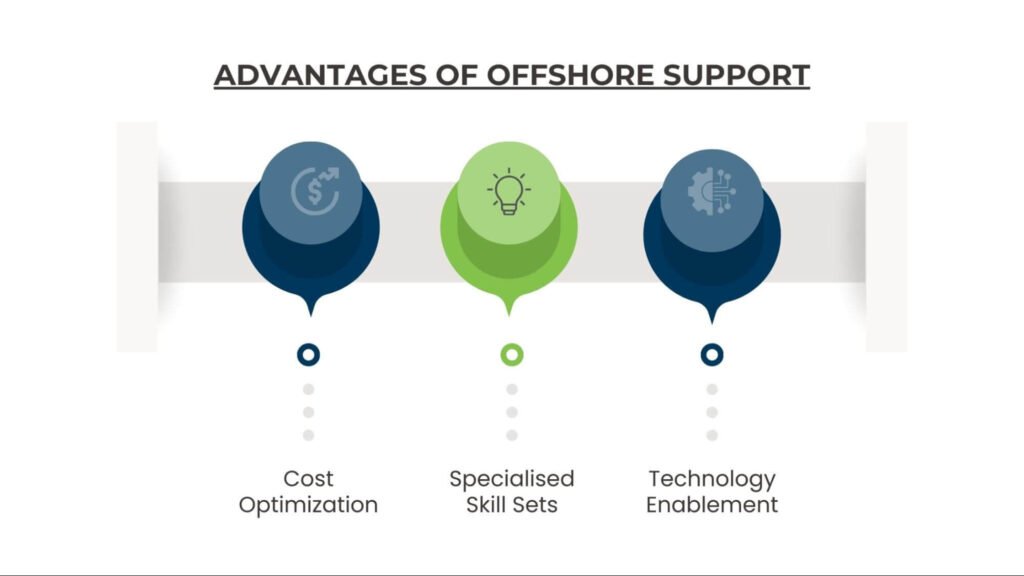
Infographic showing advantages of offshore support including cost optimization, specialized skill sets, and technology enablement

Advantages of Offshore Support

Cost Optimization
Professional offshore teams deliver CPA-qualified expertise at 40-60% lower cost than domestic hiring, enabling firms to offer competitive pricing while maintaining margins.​

Specialised Skill Sets
Leading offshore providers employ professionals trained in:

  • Canadian ASPE and IFRS standards
  • CRA audit procedures and electronic filing requirements
  • Platform-specific outsourced accounting for Shopify, Amazon, Walmart
  • Cross-border tax compliance for US-Canada operations

Technology Enablement
Offshore teams operate on cloud-based platforms with:

  • Secure client portals with PIPEDA compliance
  • Real-time collaboration tools
  • AI-powered reconciliation and anomaly detection
  • Automated backup and disaster recovery

Conclusion: Strategic Transformation Through Outsourcing

The trajectory is clear: 79% of Canadian businesses will adopt outsourced accounting by 2025. When firms outsource e-commerce accounting, they redirect internal resources toward high-value advisory services while ensuring expert-level compliance and financial outsourcing reporting

The Canadian e-commerce market is expected to approach $118.8 billion by 2028—the question is not whether to outsource, but how quickly to implement strategic partnerships.

Expert outsourcing partners with proven Canadian market experience offer the fastest path to scalability. By selecting providers demonstrating mastery of Shopify bookkeeping, Amazon accountant for an e-commerce business functions, and CRA compliance, firms position themselves as indispensable advisors in Canada’s digital economy.

Contact us to explore how specialised outsourcing can transform your practice’s e-commerce service delivery and achieve sustained growth.


Outsourcing Virtual CFO Services for Canadian Businesses: A Complete Guide

Professional CFO working remotely, representing outsourced virtual CFO services for Canadian businesses

More Canadian businesses are embracing outsourced Virtual CFO services to boost their financial outsourcing management, strategic decision-making, and regulatory compliance in a cost-effective, scalable way. 

This guide breaks down the benefits, costs, and best practices for engaging top virtual CFO professionals in Canada, with a clear focus on results for CPAs, accountants, and business owners seeking growth.

Key Takeaways:

  • Save 30–50% compared to hiring a full-time CFO, while gaining access to seasoned expertise.
  • Canadian SMEs benefit from strategic guidance, improved compliance, and stronger cash flow.
  • Flexible fractional CFO and part time CFO services scale with your business.
  • The best outsourced CFO services offer clear ROI, from better margins to higher funding success.
  • Select a provider with deep Canadian regulatory knowledge and a proven track record.

When Should Your Business Consider Outsourcing CFO Functions?

Quick Decision Table – When to Engage a CFO
TriggerCFO Engagement Recommended
Revenue leaps or new funding roundYes – strategic guidance needed
Complex compliance or CRA auditsYes – reduce risk, improve documentation
Cash flow surprises or margin erosionYes – professional forecasting essential
Growing beyond $2M annual revenueYes – monthly or project-based CFO makes sense
Tech or system migrationYes – CFO oversees seamless transition
Can't justify full-time CFO expenditureYes – fractional/part-time model saves cost

Most Canadian SMEs find ROI with part time or fractional CFO services long before they can afford a full-time CFO, making proactive engagement a powerful decision.

The Virtual CFO Advantage in Canada

Outsourced Virtual CFO services give Canadian businesses access to top-tier financial strategy without the full-time cost.

Outsource bookkeeping services and basic tax filing; they deliver budgeting, forecasting, fundraising readiness, cash management, financial systems implementation, CRA compliance, and advisory support that drives real business value.​

Why Are More Canadian Businesses Outsourcing CFO Functions?

  • Talent Shortage: With only a 3.6% unemployment rate in Canadian accounting and finance, finding experienced permanent CFOs is tough.​
  • Rising Costs: Full-time CFO compensation in Canada often tops $200,000–$400,000 per year – not including bonuses or benefits.​
  • Need for Flexibility: Fractional CFO services let businesses adjust their spend as they grow or pivot (hourly, retainer, or project-based models available).​

Strategic Edge: 20–30% better financial performance is typical for companies equipped with strong CFO guidance.​

Financial professional reviewing digital analytics dashboard while working on a laptop
What Services Do Outsourced CFOs Provide?
Core ServiceBenefit for Canadian Businesses
Financial Planning & ForecastingAlign budgets and forecasts for growth
Cash Flow ManagementAvoid liquidity crunches, improve resilience
CRA/GST/HST Compliance & ReportingReduce audit risk, streamline filing
Fundraising & Investor ReadinessPrepare winning financials for banks, VCs, or grants
Financial Systems ImplementationMove from spreadsheets to cloud platforms safely
Performance Dashboards & KPIsEnable data-driven decisions
Best-in-class outsourced chief financial officer providers tailor these core offerings to each client.
Sector-Specific CFO Impact
SectorCommon Pain PointsVirtual CFO Solutions
SaaS & TechRevenue recognition, churn, fundingCash flow modeling, investor decks, SaaS metrics
ManufacturingMargin control, inventory, cash flowCost analysis, working capital planning, vendor negotiation
Retail / E-commerceSeasonal cash, multi-channel dataReal-time dashboards, supply chain analysis, payment terms
Professional ServicesProfitability tracking, CRA auditsProject costing, offshore payroll compliance, GST/HST filing
  • SaaS companies often need help with complex revenue recognition and funding preparation; a fractional CFO delivers disciplined processes for ARR, MRR, and forecasting.
  • Manufacturers benefit from improved cost control and inventory optimisation.
  • Retailers get support managing fluctuating revenue and multi-channel performance metrics.
  • Service firms rely on outsourced CFOs for project margin analysis and managing CRA regulatory risks.

The Business Impact – ROI, Value, and Cost

What Does It Cost?

  • Full-Time CFO: $200,000–$400,000+ per year in salary, plus overhead.
  • Outsourced Virtual CFO services: $3,000–$10,000 monthly or $150–$400 per hour depending on engagement depth.
  • Fractional CFO services: 30–70% less than a traditional hire, ideal for businesses with $2M–$30M annual revenue.

Proven Results

  • 2x to 9x typical ROI, measured by improved EBITDA, cash flow, and successful funding rounds.
  • Margin improvement of 1–8% through pricing and cost control.
  • Up to 20% higher success rate securing outside capital.
  • 30% increased survival rates for businesses that utilise professional CFO oversight.

Canadian Compliance & Regulatory Factors

Staying on top of Canadian tax and CRA guidelines is critical. Skilled virtual CFOs:

  • Oversee GST/HST registration, filings, and documentation in all provinces.
  • Manage T2 corporate returns, payroll, and record retention, minimising audit triggers.
  • Ensure compliance with PIPEDA for digital accounting and document management.

They work hand-in-hand with your bookkeeper and external CPA, ensuring every process integrates for full compliance and audit-readiness.

Virtual CFO Technology Trends: Cloud, Automation & Real-Time Data

  • The best outsourced CFO services now rely on cloud accounting platforms (like QuickBooks Online, Xero) for secure, remote access and improved collaboration.
  • Automation streamlines reporting and reduces manual errors, enhancing audit readiness and compliance.
  • Advanced KPI dashboards provide instant insights into cash flow, profitability, and risk, allowing real-time decision-making.
  • Security: Encrypted sharing and multi-factor authentication maintain PIPEDA compliance for sensitive financial data.

How to Select the Right Outsourced CFO Provider

Choosing the right virtual CFO is key to maximising value. Here’s what to prioritise:

Credentials and Experience

  • Ensure CPA or MBA credentials, with proven experience in your sector.
  • Ask for case studies and references.

Regulatory & Systems Knowledge

  • Expertise in Canadian accounting standards, GST/HST, payroll, and cloud accounting.
  • Familiarity with business-specific needs (e.g., SaaS, retail, manufacturing).

Flexible Engagement Models

  • Hourly consulting for special projects.
  • Monthly retainer for ongoing support.
  • Equity-based or project-only structures for startups.

Communication and Fit

  • Responsive, clear communicators with reliable reporting cycles and proactive insights.
  • Comfortable with remote and hybrid work, using platforms preferred by your team.

Red Flags to Avoid

  • Limited Canadian regulatory knowledge.
  • Vague proposals or hidden costs.
  • No clear milestones or deliverables.
Business professionals discussing financial strategy during a meeting in a modern office

Implementation and Best Practices for Success

To maximise the return on outsourced CFO services:

  • Set clear goals, KPIs, and reporting expectations from day one.
  • Schedule regular review meetings for progress and adjustments.
  • Ensure secure sharing of data and ongoing collaboration with existing financial and tax advisors.
  • Focus on both quick wins (cash and compliance) and long-term strategic improvements (funding, expansion, ROI).
  • Tap into your virtual CFO’s network for introductions, partner discounts, and benchmarking data.

Conclusion:

Outsourcing Virtual CFO services in Canada has become a strategic necessity for businesses wanting to thrive in a fast-evolving financial environment. 

By partnering with an experienced virtual CFO, Canadian firms can access executive-level financial leadership, strategic planning, and compliance expertise at a fraction of a full-time CFO’s cost – making it possible to scale, optimise decision-making, and prepare for growth without large upfront investments. 

The flexibility and cost efficiency of fractional and part time CFO services empower small businesses and SMEs to respond rapidly to new opportunities and regulatory changes, while maintaining a resilient financial foundation. 

Companies adopting best outsourced CFO services build the foundation for better reporting, robust compliance, and confident expansion in Canada’s competitive marketplace.

Cost of Outsourcing Accounting Services in Canada

Banner showing the cost of outsourced accounting services in Canada with a person holding dollar bills

Cost of Outsourcing Accounting Services in Canada

Managing financial operations efficiently is crucial for business success, yet many Canadian enterprises struggle with the mounting costs and complexities of maintaining in-house accounting departments. 

As we approach 2026, understanding the cost of outsourcing accounting services has become essential for CPAs, accountants, and business owners seeking to optimise their financial management strategies while controlling expenses.​

Recent industry data reveals that 36.5% of Canadian businesses have already outsourced professional services such as accounting and bookkeeping, with adoption rates climbing from 55% in 2018 to 75% in 2023. 

This dramatic shift reflects how outsourcing has evolved from a cost-cutting measure into a strategic business advantage that delivers expertise, scalability, and competitive edge.

Key Takeaways

  • Monthly outsourced accounting services cost ranges from $500 to $10,000, depending on business size and service complexity
  • Canadian businesses save 40-60% by outsourcing compared to maintaining in-house accounting teams
  • Pricing models include hourly rates, fixed monthly fees, per-transaction, and tiered packages, offering flexibility
  • The Canadian BPO sector is projected to grow from CAD 28.9 billion (2024) to CAD 46.7 billion by 2030
  • Over 54% of Canadian SMBs have outsourced core accounting functions, with efficiency improvements reported by 72% of firms

Understanding Outsourced Accounting Service Costs in Canada

What Determines the Cost of Outsourcing Accounting Services?

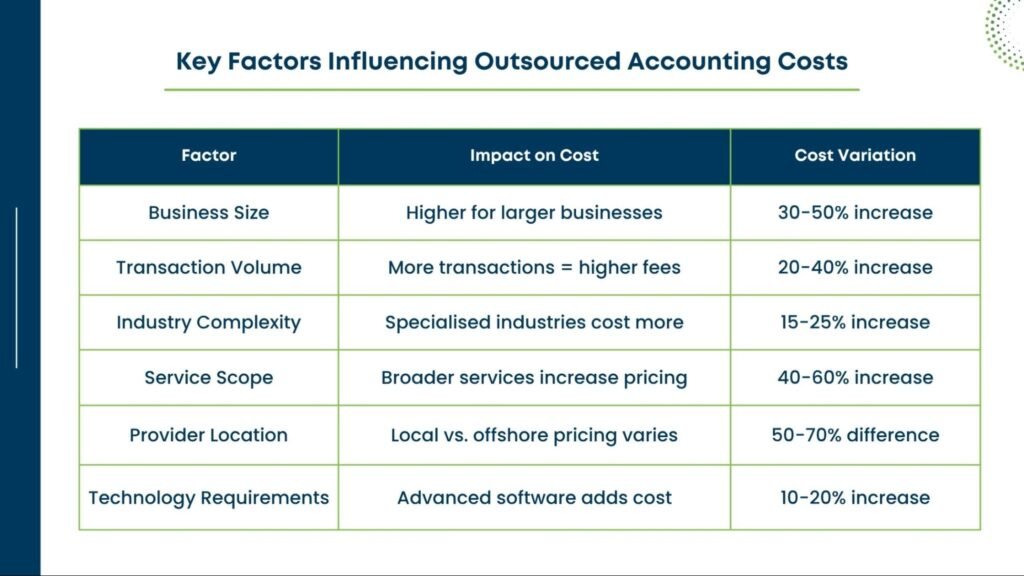
The cost of outsourcing accounting services varies significantly based on several critical factors that Canadian businesses must consider:​

Business Size and Complexity

Larger organisations with multiple entities, complex transactions, and extensive reporting requirements naturally incur higher costs. Small businesses with straightforward bookkeeping needs can expect to pay substantially less than mid-market enterprises requiring comprehensive financial management.​

Transaction Volume

The number of monthly transactions directly impacts pricing. Businesses processing hundreds of invoices, payments, and reconciliations require more extensive service hours, increasing outsourced bookkeeping rates accordingly.​

Industry-Specific Requirements

Specialised industries such as healthcare, cannabis, real estate, and e-commerce often require industry-specific expertise and compliance knowledge, which commands premium outsourced accounting pricing.​

Service Scope and Frequency

Basic bookkeeping services cost considerably less than comprehensive packages that include payroll processing, tax preparation, financial analysis, and CFO-level strategic guidance.​

Provider Location and Expertise

Outsourcing to local Canadian providers versus offshore destinations can result in 50-70% pricing differences. However, local providers offer advantages, including time zone alignment, regulatory familiarity, and cultural compatibility.​

Technology and Software Requirements

Advanced accounting platforms, automated workflows, and real-time reporting capabilities may increase costs by 10-20%, though these investments typically deliver substantial efficiency gains.​ 

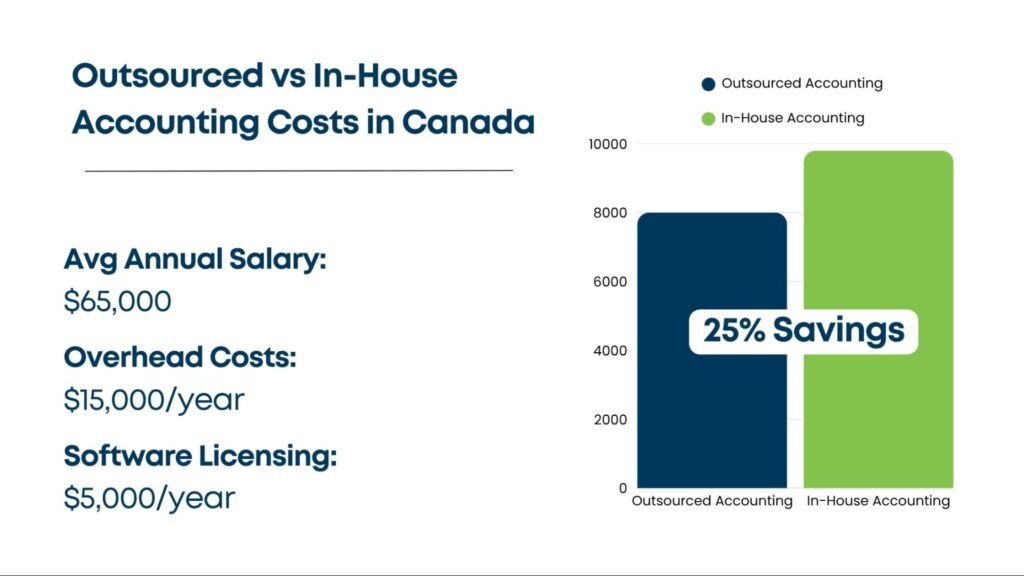
Comparison chart showing outsourced versus in-house accounting costs in Canada with 25 percent savings

How Much Does Outsourced Accounting Cost? Pricing Breakdown

Monthly Cost Ranges for Canadian Businesses
Service LevelMonthly Cost Range (CAD)Typical Services Included
Basic Bookkeeping$500 – $1,000Transaction recording, bank reconciliation, basic reports
Standard Accounting Package$1,000 – $2,000Monthly bookkeeping, sales tax filing, financial statements
Comprehensive Services$2,000 – $3,000Full bookkeeping, payroll, tax preparation, financial analysis
Full-Service with CFO Support$3,000 – $5,000All above + CFO guidance, budgeting, cash flow forecasting
Enterprise-Level Services$5,000 – $10,000+Multi-entity reporting, advanced analytics, compliance

These figures align with Statistics Canada data showing that professional service outsourcing has become mainstream across 36.5% of Canadian businesses.

Understanding Different Pricing Models

Hourly Rate Pricing

Canadian outsourced accounting pricing for hourly services ranges from $25 to $150 per hour, with experienced CPAs commanding rates at the higher end. This model suits businesses requiring occasional consulting or project-based assistance rather than ongoing support.

Fixed Monthly Fee

The most popular model among Canadian businesses, fixed monthly fees provide cost predictability and typically range from $500 to $5,000 depending on service scope. This approach works exceptionally well for businesses with consistent transaction volumes and regular reporting needs.

Per-Transaction Pricing

Ideal for seasonal businesses or companies with fluctuating activity levels, per-transaction pricing typically costs $1 to $5 per transaction. This model ensures businesses only pay for actual work performed.

Tiered Package Pricing

Many Canadian providers, including a trusted outsourcing company, offer tiered packages allowing businesses to select appropriate service levels and scale as they grow. Entry-level packages start around $500 monthly, with premium tiers reaching $10,000 or more.

Value-Based Pricing

Strategic financial planning and CFO-level advisory services often use value-based pricing, where costs align with the business impact delivered rather than hours worked. This model suits growing businesses seeking transformational financial guidance.

In-House vs Outsourced Accounting – Cost Comparison
AspectIn-House Accounting (CAD)Outsourced Accounting (CAD)Savings Potential
Monthly Cost$5,400 – $7,500/month$500 – $5,000/month40–60%
Annual Cost$65,000 – $90,000/year$6,000 – $60,000/year30–70%
Expertise AccessLimited to staff skillsTeam of specialistsMultiple expert access
ScalabilityDifficult and expensiveFlexible and instantUnlimited flexibility
Technology InvestmentRequired ($3,000–$5,000)Included in service100% savings
Training & BenefitsRequired (35–40% overhead)Not required100% savings

Industry statistics reveal that Canadian businesses can reduce accounting costs by 40-50% through outsourcing compared to maintaining in-house teams. According to Deloitte research, 54% of Canadian small businesses outsource accounting primarily to manage compliance complexity while reducing operational expenses.

Table listing key factors influencing outsourced accounting costs such as business size, transaction volume, industry complexity, and provider location

What Canadian Businesses Should Expect When Outsourcing

Services Typically Included in Outsourced Accounting Packages

Core Bookkeeping Services

  • Daily transaction recording and categorisation
  • Bank and credit card reconciliation
  • Accounts payable and receivable management​
  • General ledger maintenance
  • Month-end and year-end closing procedures

Tax Compliance and Preparation

  • GST/HST return preparation and filing
  • Corporate tax return preparation (T2)
  • Individual tax returns (T1)
  • Payroll tax compliance (T4, T4A)​
  • Tax planning and optimisation strategies

Financial Reporting and Analysis

  • Monthly financial statements (P&L, balance sheet, cash flow)​
  • Budget preparation and variance analysis
  • Key performance indicator (KPI) tracking
  • Custom reporting dashboards
  • Management reporting packages

Strategic Services
Outsourced CFO services, including cash flow forecasting, financial modelling, strategic planning, and business advisory support, are increasingly popular among Canadian mid-market businesses.​

Technology and Software Integration

Modern Accounting outsourcing providers leverage cloud-based platforms, including QuickBooks Online, Xero, Sage Intacct, and NetSuite, to deliver real-time financial visibility. According to industry data, 86% of Canadian accountants currently use cloud accounting software, with 84% planning to adopt AI solutions soon.

Hidden Costs and Considerations

While evaluating how much outsourced accounting costs, Canadian businesses should consider several additional factors beyond base pricing:

Setup and Onboarding Fees

Initial setup typically ranges from $500 to $2,500, covering data migration, system configuration, and process documentation. Reputable providers like professional accounting firms often waive or reduce these fees for long-term contracts.​

Software and Licensing Costs

Some providers include software costs in their monthly fees, while others charge separately. Clarify whether QuickBooks, Xero, or other platform licenses are included in the quoted outsourced accounting services cost.​

Seasonal Fluctuations

Tax season and year-end closing periods may incur temporary cost increases of 15-30% due to increased workload demands.​

The Future of Accounting Outsourcing Costs in Canada

As we approach 2026, several trends are reshaping outsourced accounting pricing:

AI and Automation Impact

Artificial intelligence and machine learning are reducing costs for routine tasks while increasing value for strategic advisory services. The Canadian BPO market is projected to reach US$9.82 billion by 2030, growing at 3.47% annually.​

Increased Adoption Rates

With 79% of Canadian businesses expected to outsource accounting by 2025, market competition is driving improved service quality and competitive pricing.​

Regulatory Complexity

Evolving compliance requirements, including ESG reporting frameworks and international financial standards, are increasing demand for specialised expertise available through financial outsourcing.​

Making the Right Choice for Your Business

Selecting the appropriate outsourcing partner requires evaluating multiple factors beyond price alone:

Provider Credentials and Experience

Verify that providers employ qualified professionals with relevant certifications (CPA, CGA, CMA) and Canadian tax return outsourcing.​

Technology Capabilities

Ensure compatibility with your existing systems and access to modern cloud-based platforms offering real-time reporting.​

Data Security and Compliance

Confirm providers maintain ISO 27001 certification and robust cybersecurity measures protecting sensitive financial information.​

Scalability and Flexibility

Choose partners capable of scaling services as your business grows without significant cost increases or service disruptions.​

References and Track Record

Request client testimonials and case studies demonstrating successful partnerships with businesses similar to yours.​

The cost of outsourcing accounting services in Canada represents a strategic investment rather than merely an expense. With monthly costs ranging from $500 for basic bookkeeping to $10,000+ for comprehensive enterprise solutions, Canadian businesses can achieve 40-60% cost savings compared to in-house teams while accessing superior expertise and technology.​

Conclusion

As the Canadian BPO market continues expanding toward CAD 46.7 billion by 2030, businesses embracing outsourced accounting position themselves for enhanced financial clarity, regulatory compliance, and sustainable growth. 

Whether you’re a small business seeking basic bookkeeping support or a mid-market enterprise requiring comprehensive financial management, understanding pricing structures and cost drivers enables informed decisions that drive long-term success.​

Pricing accounting services, understanding how much outsourced accounting costs is essential for choosing the right level of support and ensuring alignment with your budget and operational needs.

By partnering with offshore accountants, Canadian CPAs and accountants can focus on high-value client advisory services while delegating routine tasks to specialised teams, ultimately improving profitability, client satisfaction, and competitive positioning in an increasingly complex financial landscape.

Pros & Cons of Outsourcing Accounting Services in Canada

Banner image with text “Outsourcing Accounting Services in Canada: Pros and Cons” and people working with financial reports and a calculator.

Outsourced accounting services have become essential for Canadian businesses seeking financial efficiency and strategic growth. With more than 54% of Canadian SMBs having already outsourced core accounting activities, understanding both advantages and challenges is critical for informed decision-making.​

The Canadian BPO market generated approximately CAD 28.9 billion in revenues in 2024, with projections indicating growth to CAD 46.7 billion by 2030. This remarkable expansion underscores growing confidence in financial outsourcing across diverse industries.​

Key Takeaways

  • More than 54% of Canadian SMBs have outsourced core accounting activities, demonstrating widespread adoption​
  • Outsourced accounting services reduce operational costs by 40-50% compared to maintaining in-house teams​
  • Offshore bookkeeping provide real-time financial access and scalability for growing businesses​
  • 86% of Canadian accountants and bookkeepers utilise cloud accounting software, enabling advanced technological capabilities​
  • Selecting the right provider requires a thorough evaluation of compliance expertise, data security, and industry specialisation

The Rising Adoption of Outsourced Accounting in Canada

Growth Trends in Outsourcing

Canadian businesses are increasingly recognising the strategic value of outsourced accounting for small business arrangements. Professional services represent the most commonly outsourced business functions, with 36.5% of Canadian businesses having outsourced these activities in the first quarter of 2025. 

Many of these businesses are now turning to online accounting services for small businesses to streamline operations, reduce overhead, and gain real-time financial insights. This trend highlights how digital solutions are reshaping how Canadian SMEs approach accounting and back-office management.

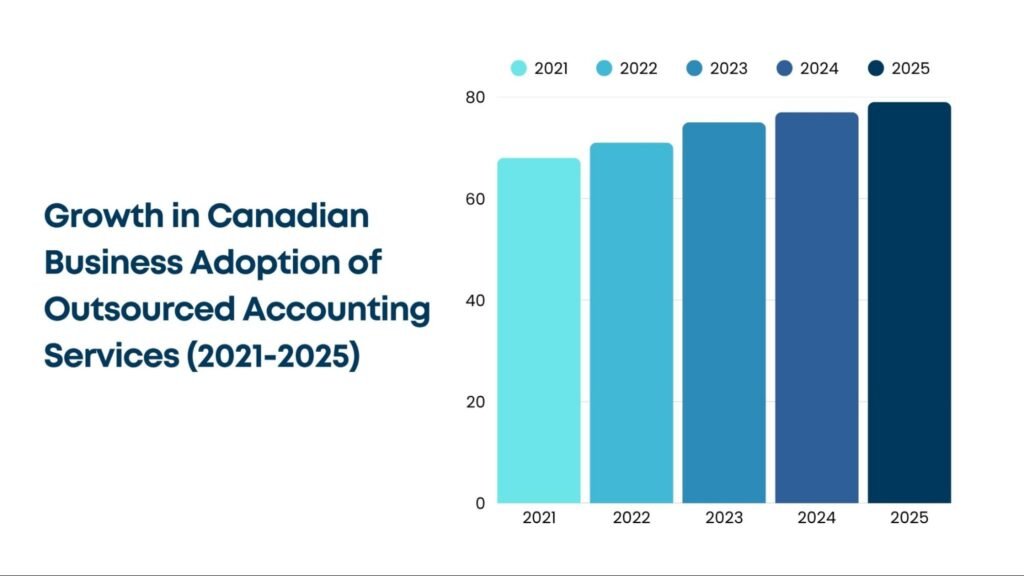
Bar chart showing the steady growth in Canadian businesses adopting outsourced accounting services from 2021 to 2025.

The adoption trajectory demonstrates consistent acceleration. From 2018 to 2023, Canadian business adoption of outsourced accounting services increased from 55% to 75%, representing a 20-percentage-point expansion over five years. This trend reflects fundamental shifts in how businesses approach financial management.

Why Canadian Businesses Are Outsourcing

Virtual bookkeeping services address multiple business challenges simultaneously: rising labour costs, complexity of compliance requirements, need for technological sophistication, and pressure to focus resources on revenue-generating activities. 

For Canadian CPAs and accounting professionals, this shift represents both competitive pressure and a significant opportunity to reposition their practices toward higher-value advisory services.

The Advantages of Outsourced Accounting Services

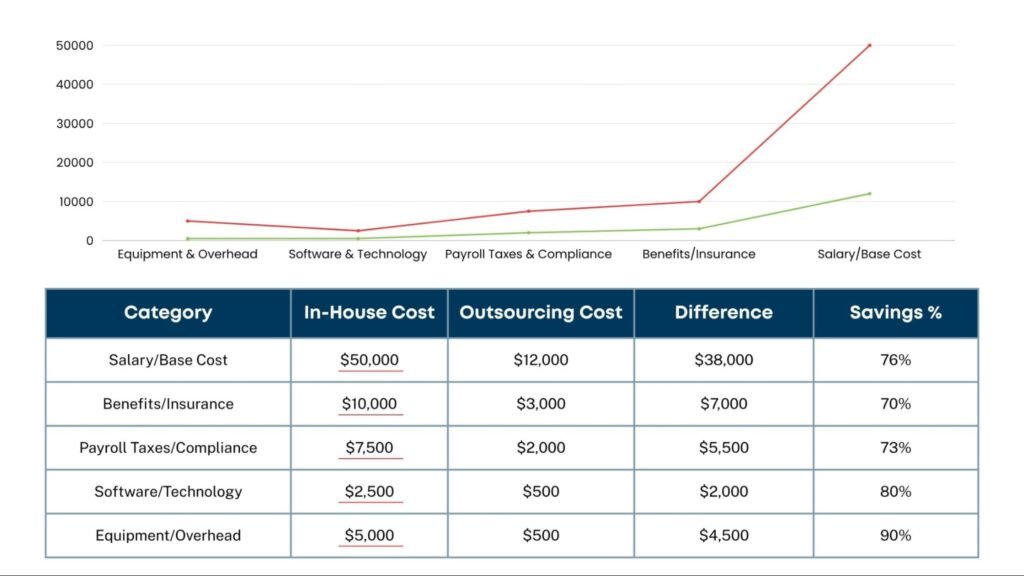
1. Significant Cost Reductions

Key Point: Professional providers offer CPA-level expertise without requiring full-time employment commitments.

The complexity of Canadian tax regulations—including federal CRA requirements, provincial variations, GST/HST administration, and industry-specific compliance—demands specialised knowledge. 

A 2024 Deloitte survey revealed that 54% of small businesses outsource accounting specifically to address compliance complexity. Many of these businesses choose to outsource accounting for small businesses to gain access to expert guidance without the overhead of hiring internally.

Professional outsourced bookkeeping services providers employ certified accountants who remain current with evolving tax laws, accounting standards (ASPE, IFRS), and regulatory requirements. This expertise substantially reduces compliance risk and error likelihood.

Chart comparing in-house and outsourcing accounting costs in Canada, showing cost savings across salary, benefits, payroll, software, and equipment categories.

2. Access to Specialised Expertise

Key Point: Professional providers offer CPA-level expertise without requiring full-time employment commitments.

The complexity of Canadian tax regulations, including federal CRA requirements, provincial variations, GST/HST administration, and industry-specific compliance, demands specialised knowledge. A 2024 Deloitte survey revealed that 54% of small businesses outsource accounting specifically to address compliance complexity.​

Professional outsourced bookkeeping services providers employ certified accountants who remain current with evolving tax laws, accounting standards (ASPE, IFRS), and regulatory requirements. This expertise substantially reduces compliance risk and error likelihood.​

3. Enhanced Scalability and Flexibility

Key Point: Outsourced providers adapt to changing business needs without organisational disruption.

During peak periods (year-end closing, tax season), outsourcing accounting for small business providers can increase service levels and deploy additional resources. During slower periods, businesses scale back services without staffing complications.​

This flexibility proves particularly valuable for startups and rapidly growing enterprises. Industry research indicates 57% of Canadian accounting practices expanded client lists in 2025, reflecting both business growth and confidence in outsourced solutions.​

4. Technology Access and Innovation

Key Point: Professional providers invest in advanced platforms exceeding what most businesses can afford independently.

Leading outsourced accounting services providers utilise cloud-based platforms (QuickBooks Online, Xero, Sage Intacct), automation tools, and artificial intelligence. The adoption rate among Canadian accountants reaches 86% for cloud accounting software, and 84% express readiness to incorporate AI.​

These technological capabilities enable real-time financial visibility, automated bank reconciliation, seamless collaboration, and mobile accessibility – benefits that would require substantial capital investment for businesses implementing independently.

Group of business professionals smiling and collaborating around a laptop during a meeting in a modern office setting.

5. Strategic Focus on Core Business

Key Point: Outsourcing reclaims time and mental bandwidth for revenue-generating activities.

Business owners spending 10-15 hours monthly on accounting tasks sacrifice valuable time for strategic planning, customer relationships, and business development. Over 72% of companies using outsourced accounting services reported increased efficiency in 2023, up significantly from 60% in 2018.​

Challenges and Drawbacks

1. Perceived Loss of Control

Key Point: External management of financial processes can create discomfort for detail-oriented owners.

When accounting functions are outsourced, business owners delegate financial oversight to external professionals. While this concern is understandable, it can be mitigated through:

  • Clear communication protocols and regular reporting schedules
  • Transparent service level agreements
  • Defined performance metrics
  • Access to real-time financial dashboards

2. Data Security and Confidentiality

Key Point: Entrusting sensitive financial information requires rigorous security verification.

Reputable outsourced bookkeeping services providers implement encryption, secure servers, and PIPEDA compliance. However, businesses must verify:

  • SOC 2 security certifications
  • Data protection policies
  • Disaster recovery procedures
  • Insurance coverage

Selecting the Right Provider in Canada

Critical Selection Criteria

  • Industry Experience: Choose providers with demonstrated expertise in your sector. Industry specialised advisers understand sector-specific challenges and regulatory nuances.​
  • Compliance Expertise: Verify knowledge of federal CRA requirements, provincial obligations, and applicable accounting standards.​
  • Technology Capabilities: Ensure proficiency with QuickBooks, Xero, or Sage platforms and cloud-based collaboration tools.​
  • Data Security: Confirm compliance with PIPEDA and Canadian privacy legislation, plus relevant security certifications.​
  • Track Record: Research client testimonials, case studies, retention rates, and professional affiliations with CPA Canada or industry associations.​

Conclusion: Strategic Financial Management for Canadian Businesses

Outsourced accounting services have evolved from cost-reduction tactics into strategic enablers supporting business growth. The 79% adoption projection for 2025 demonstrates mainstream acceptance across Canadian business sectors.​

For businesses seeking virtual bookkeeping services, cloud-based financial management, and strategic accounting partnerships, the evidence overwhelmingly supports thoughtful outsourcing arrangements. 

With cost savings approaching 50%, access to specialised expertise, enhanced scalability, advanced technology, and operational focus, outsourcing accounting for small business arrangements offers compelling competitive advantages.​

Businesses implementing structured selection and monitoring processes position themselves to leverage financial outsourcing effectively while maintaining appropriate oversight and control.

In Canada’s evolving business landscape, organisations that strategically embrace specialised expertise and advanced technology will achieve superior financial outcomes and sustainable competitive advantage. Connect with our team.

How to Choose Right Outsourced Accounting Partner in Canada

Business professional holding a tablet beside text that reads “How to Choose the Right Outsourced Accounting Partner in Canada!” on a modern blue and green design background.

How to Choose the Right Outsourced Accounting Partner in Canada

Finding the ideal outsourced accounting partner is a critical decision that can transform your small business’s financial management and drive sustainable growth. 

The Canadian accounting outsourcing market has experienced remarkable growth, with the Business Process Outsourcing sector projected to reach US $8.28 billion in 2025, showing an annual growth rate of 3.47%. 

This surge reflects small businesses’ growing recognition of outsourcing’s strategic value in addressing talent shortages, regulatory complexities, and cost pressures while maintaining operational excellence.​

Key Takeaways

  • Cost Efficiency: Outsourcing reduces overhead expenses by up to 50% compared to maintaining in-house accounting teams
  • Access to Expertise: Gain immediate access to specialised professionals familiar with Canadian tax laws and CRA compliance
  • Scalable Solutions: Adjust service levels based on business needs without the complexities of hiring or downsizing staff
  • Technology Advantages: Leverage advanced cloud-based accounting software without significant upfront investments
  • Risk Mitigation: Ensure compliance with Canadian regulations while reducing errors and audit risks

Understanding the Canadian Outsourcing Landscape

The demand for remote accounting firms in Canada has intensified significantly. According to recent research, 36.5% of Canadian businesses already outsource professional services such as accounting, and this trend continues to accelerate as businesses seek more efficient financial management solutions.​

Key Market Insights:

  • 42% of Canadian SMEs fear closure due to cost surges, yet 35% still manage their own finances instead of seeking professional help​
  • 80% of Canadian accounting firms successfully adapted to remote work capabilities​
  • The Business Process Outsourcing sector is experiencing 3.47% annual growth​
  • Only 10-15% of Canadian businesses currently use cloud-based accounting systems, indicating a significant opportunity for improvement​

Technological advances and changing work patterns have accelerated the shift towards virtual accounting firm partnerships. Wolters Kluwer’s Canadian Accounting Industry Survey found that 75% of firms report their tax compliance software facilitates remote work transitions, making outsourcing more seamless and reliable than ever before.

Industry Expertise and Canadian Compliance Knowledge

Your chosen outsourced accounting partner must demonstrate a deep understanding of Canadian regulatory requirements. Essential qualifications include:

  • Proficiency in CRA guidelines and reporting standards
  • Expert knowledge of GST/HST compliance across provinces
  • Understanding of provincial tax variations and filing requirements
  • Experience with Canadian payroll regulations and T4 processing
  • Industry-specific regulatory knowledge relevant to your sector​

Technology Infrastructure and Software Compatibility

Modern accounting outsourcing solutions depend heavily on robust technology platforms. Your ideal partner should offer:

Must-Have Technology Features:

  • Cloud-based accounting software (QuickBooks Online, Xero, or Sage Intacct)​
  • Real-time financial dashboard and reporting capabilities
  • Mobile accessibility for on-the-go financial management
  • Automated bank reconciliation and transaction categorisation
  • Multi-user access with customisable permission levels
  • Integration capabilities with existing business software
  • Software-agnostic approach for maximum flexibility
Comprehensive Service Offerings Comparison
Service CategoryBasic PackageProfessional PackageEnterprise Package
BookkeepingMonthly reconciliationWeekly reconciliationDaily reconciliation
PayrollNot includedBasic processingAdvanced with benefits management
Tax PreparationT1 filing onlyT1 + GST/HSTComplete corporate tax planning
Financial ReportingQuarterlyMonthlyReal-time dashboards
Advisory ServicesNot includedQuarterly consultationsOngoing strategic support
CRA SupportNot includedCorrespondence handlingFull audit support

Evaluating Service Offerings and Scalability

What to Expect from Outsourced Accounting Services for Small Businesses

The best outsourced accounting services in Canada providers offer comprehensive solutions beyond basic bookkeeping:

Core Services:

  • Accounts payable and receivable management
  • Monthly bank reconciliation and financial statement preparation
  • Payroll processing and T4 preparation
  • GST/HST filing and remittance
  • Year-end tax preparation and CRA liaison

Advanced Services:

  • Cash flow forecasting and management
  • Financial analysis and KPI reporting
  • Budgeting and variance analysis
  • Strategic tax planning and optimisation
  • CFO-level advisory services
  • Merger and acquisition support

Scalability and Flexibility Considerations

Your outsourcing accounting and bookkeeping services partner should be able to accommodate your business’s evolving needs. The Canadian payroll and bookkeeping services industry, valued at CAD $7.4 billion in 2024, offers numerous providers with varying scalability capabilities.

Questions to Ask About Scalability:

  • How quickly can you increase service levels during peak periods?
  • What is your process for adjusting services as our business grows?
  • Do you charge penalties for reducing service levels if needed?
  • Can you support multi-location operations as we expand?
  • What happens if our transaction volume doubles or triples?

Cost Structure and Value Assessment

Pricing Models Comparison
Pricing ModelBest ForTypical Range (CAD Monthly)ProsCons
Hourly RateProject-based needs$50–150/hourPay only for time usedUnpredictable monthly costs
Monthly RetainerConsistent service needs$500–3,000Predictable budgetingMay pay for unused hours
Per TransactionHigh-volume businesses$0.50–2.00 per transactionScales with activityComplex pricing structure
Tiered PackageGrowing businesses$800–2,500Clear service levelsMay outgrow the tier quickly

Return on Investment Analysis

Outsourcing bookkeeping services delivers value beyond direct cost savings:

Direct Financial Benefits:

  • 30-50% reduction in accounting costs compared to in-house teams​
  • Elimination of employee benefits, training, and overhead expenses
  • No software licensing or hardware investment requirements
  • Reduced error-related costs and penalty avoidance

Indirect Strategic Benefits:

  • 15-20 hours per week freed for core business activities
  • Access to specialised expertise without full-time salary commitments
  • Improved financial reporting quality, enabling better decisions
  • Enhanced scalability without recruitment challenges
  • Reduced audit risk through professional oversight

Due Diligence Checklist

Before Making Your Final Decision:

  • Request and verify at least 3 client references from similar businesses
  • Review case studies demonstrating Canadian regulatory expertise
  • Confirm professional certifications (CPA designation preferred)
  • Evaluate their client portal and technology platform firsthand
  • Request detailed service level agreements (SLAs)
  • Verify insurance coverage (E&O and cyber liability)
  • Assess their team’s depth and backup support capabilities
  • Review their disaster recovery and business continuity plans
  • Understand their data migration and onboarding process

Clarify contract terms, termination clauses, and data ownership

Common Pitfalls to Avoid

Red Flags When Selecting Partners:

  • Unwillingness to provide references or case studies
  • Lack of industry-specific certifications or credentials
  • Vague or confusing pricing structures with hidden fees
  • Poor communication during the evaluation process
  • No clear service level agreements or performance guarantees
  • Outdated technology platforms or manual processes
  • Offshore-only operations without Canadian business hours support
  • Resistance to answering detailed security questions

Making the Final Decision

Implementation Planning Timeline
PhaseDurationKey Activities
Week 1–2SetupContract finalisation, system access configuration
Week 3–4Data MigrationHistorical data transfer, chart of accounts setup
Week 5–6IntegrationSoftware integration, workflow establishment
Week 7–8TrainingTeam training, process documentation
Month 3OptimisationPerformance review, process refinement

The right partnership with outsourced accounting services can transform your business’s financial outsourcing, providing the expertise, technology, and scalability needed to support growth and ensure compliance in Canada’s complex regulatory environment.

Conclusion

Selecting the right outsourced accounting partner represents a strategic investment in your business’s future success. By carefully evaluating expertise, technology capabilities, security measures, and cultural alignment, Canadian small businesses can establish partnerships that provide significant competitive advantages.

For Canadian businesses seeking to navigate today’s complex financial landscape, partnering with the right outsourced accounting services for small businesses provider offers a pathway to enhanced efficiency and accelerated growth.

Whether you need basic outsourcing bookkeeping services or sophisticated financial analysis support through comprehensive accounting solutions, the right partnership provides the foundation for long-term success in Canada’s competitive business environment.

Take the next step by connecting with our team that aligns with your business goals.